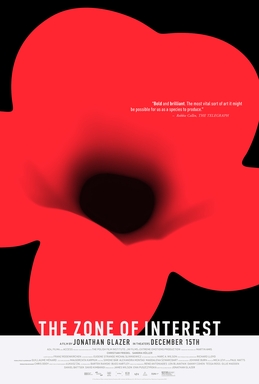
Poster © A24. Shown at reduced size for review and commentary.
|
GenreDrama, History & War
RatedPG-13
Runtime1 hr 45 mins
ReleasedDecember 15, 2023
StreamingSee Where to Watch
DirectorJonathan Glazer
StarringChristian Friedel, Sandra Hüller
|
The Zone of Interest (2023)
| ▶Stream It | ★The Numbers |
| 🎫Get Tickets | ✎Edit History |
| iIMDb Profile | %Rotten Tomatoes |
| WWikipedia | LLetterboxd |
| TTMDB | +Add to Top 8 |
| The Zone of Interest's Details | |
| Genre | Drama, History & War |
| Rated | PG-13 |
| Released | 05/19/2023 (Cannes); 12/15/2023 (United States); 02/02/2024 (United Kingdom); 02/09/2024 (Poland) |
| Streaming | See Where to Watch on this page. |
| Running Time | 1 hr 45 mins |
| Budget | Not reported |
| Box Office | Updated daily from Box Office Mojo. See the numbers below. |
| Based On | The Zone of Interest by Martin Amis |
| Country | United Kingdom, Poland, United States |
| Language | German, Polish, Yiddish |
| The Zone of Interest's Interests | |
| General | A garden wall, a quiet house, a river, flower beds, daily routines, and sound that carries over the wall. |
| Music | Mica Levi. Human voices and synths, used sparingly, mostly at the very start and the very end. |
| Movies | Schindler's List (1993) and Son of Saul (2015). Two more films that face the Holocaust head on. |
| Television | The U.S. and the Holocaust. Ken Burns on what the world knew, and what it did about it. |
| Heroes | Aleksandra Bystroń-Kołodziejczyk, the real Polish girl whose courage inspired the film's quiet act of defiance. |
| The Zone of Interest's Crew | |
| Director | Jonathan Glazer |
| Writers | Jonathan Glazer |
| Producers | James Wilson, Ewa Puszczyńska |
| Cinematography | Łukasz Żal |
| Music | Mica Levi |
| Edited By | Paul Watts |
| Production | JW Films, Extreme Emotions, Film4, Access Entertainment, Polish Film Institute |
| Distributed By | A24 (United Kingdom and United States), Gutek Film (Poland) |
Jonathan Glazer never takes his camera over the wall in The Zone of Interest, and some viewers will find that restraint harder to sit through than any image he could have shown. The year is 1943. Rudolf Höss runs Auschwitz and goes home every evening to a comfortable family house that shares a wall with the camp. His wife Hedwig, played by Sandra Hüller, tends her garden and fights to keep the house when he’s transferred to Oranienburg. Weekends mean swimming and fishing with the kids. Everything that matters reaches you through sound, and Johnnie Burn’s sound design and Mica Levi’s score are why the film works. The days are deliberately flat and even, which can feel static, and a few critics called the formal choices more pose than purpose. Mostly, the restraint is the point. It holds a 93% on Rotten Tomatoes. A 9.1 because it makes the ordinary routines around an atrocity the thing you can’t shake. $2,248 says the ordinary sounds of your own home, a door, a kettle, a dog, stay with you differently tonight.
What works: Glazer’s patient, distant camera and the relentless sound design make the family’s ordinary routine the most disturbing thing in the film, without a single graphic image.
What doesn’t: The flat, repetitive rhythm of the household’s days can feel static, and the film offers almost no conventional story to hold onto.
Who it’s for: Viewers ready for a quiet, demanding film about history that trusts them to listen closely and sit with what they hear.
Spoilers
Höss is handed a new assignment that will send him back to Auschwitz. Walking down a dark stairway in Berlin, he is suddenly sick and stares into the shadows, and the film cuts to present-day staff cleaning the Auschwitz-Birkenau museum before returning to him as he descends into the dark.
It is 1943. Rudolf Höss (Christian Friedel), the commandant of Auschwitz, lives with his wife Hedwig (Sandra Hüller) and their five children in a house that sits right against the camp wall. He takes the kids swimming and fishing. She fusses over her flower beds. Prisoners do the household chores, and the sounds from the other side of the wall never stop. Director Jonathan Glazer, drawing on the Martin Amis novel, keeps the camera inside the family's ordinary routine and lets what you hear tell the rest. Quiet, restrained and devastating. One hundred five minutes, and it stays with you long after.
Viewers ready for a film that asks you to listen closely. Go in prepared, and talk about it after.

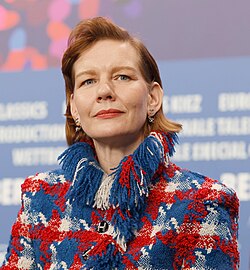





| Christian Friedel | Rudolf Höss |
| Sandra Hüller | Hedwig Höss |
| Johann Karthaus | Klaus Höss |
| Luis Noah Witte | Hans Höss |
| Nele Ahrensmeier | Inge-Brigit Höss |
| Lilli Falk | Heidetraut Höss |
| Anastazja Drobniak, Cecylia Pekala | Annegret Höss |
| Kalman Wilson | Annegret Höss |
| Medusa Knopf | Elfryda |
| Maximilian Beck | Schwarzer |
| Andrey Isaev | Bronek |
| Stephanie Petrowitz | Sophie |
| Martyna Poznanski | Marta |
| Zuzanna Kobiela | Aniela |
| Marie Rosa Tietjen | Hedwig's friend |
| Imogen Kogge | Hedwig's mother |
| Ralph Herforth | Oswald Pohl |
| Daniel Holzberg | Gerhard Maurer |
| Freya Kreutzkam | Eleonore Pohl |
| Sascha Maaz | Arthur Liebehenschel |
| Julia Polaczek | Aleksandra Bystroń-Kołodziejczyk |
| Wolfgang Lampl | Hans Burger}} |
- (cur | prev) 14:30, 20 October 2026 DataBot +400 Numbers refreshed: Worldwide box office $52.7M; Domestic box office $8.7M; profit note now waits on a budget; Rotten Tomatoes 93%; box office chart updated; Rotten Tomatoes critics 93% (356 reviews); Metacritic 92 / 100; Rotten Tomatoes audience 79% (250+ verified ratings); IMDb users 7.3 / 10 (193,764 votes); movie.guru score 8.6.
- (cur | prev) 12:00, 20 October 2026 DataBot +2,000 Profile created from Wikipedia and Box Office Mojo: cast, crew, release dates, budget, official trailer.